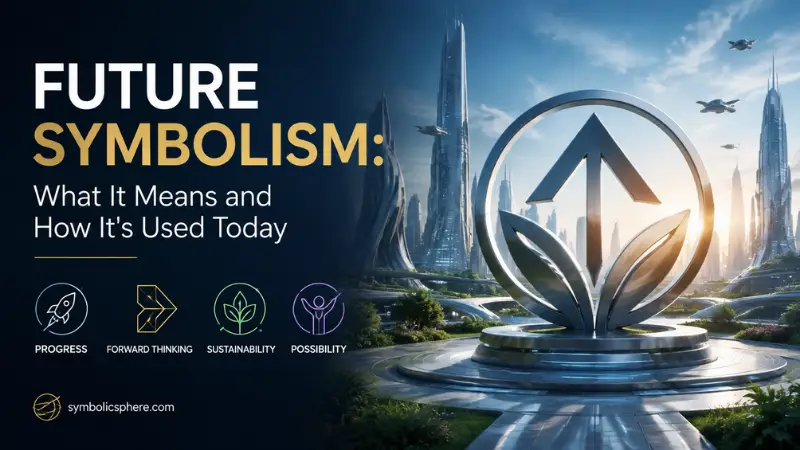
Certain images make people think instantly of what’s coming next — a rising arrow, a glowing horizon, a rocket lifting off, a clock face turned toward tomorrow. These are the visual shorthand of future symbolism, and they show up everywhere from tech logos to graduation speeches. Most people never stop to ask why an arrow pointing up reads as “progress,” but the associations are consistent enough to function almost like a shared visual language.
Future symbolism matters because it shapes how people express hope, ambition, risk, and change without needing to explain themselves. A single image — a seedling, a spaceship, a sunrise — can carry an entire attitude toward what’s ahead. In American culture, where optimism about progress has long been part of the national self-image, these symbols quietly influence advertising, politics, personal milestones, and art.
This article breaks down where these symbols come from, how they evolved, and how they function in everyday American life today — from tattoos to tech branding to the language people use at weddings and graduations.
Quick Answer: What Does Future Symbolism Mean?
Future symbolism represents progress, ambition, and hope, most commonly shown through images like rising arrows, sunrises, rockets, and open roads in graduation cards, tech branding, and tattoos. Older traditions expressed the same underlying idea through prophecy, celestial signs, and mechanical imagery tied to each era’s vision of what was coming.
TL;DR
- Future symbolism centers on progress, ambition, and forward motion.
- Older traditions expressed it through prophecy, stars, and mechanical imagery.
- American culture favors optimistic, individual-achievement versions of it.
- Tech and design fields rely heavily on future-coded visuals like arrows and light.
- The meaning shifts depending on whether it signals hope, anxiety, or both.
- Science fiction has reshaped what “the future” looks like visually.
What Future Symbolism Looks Like
Future symbolism isn’t one single image — it’s a family of visual cues people associate with what’s ahead. Common examples include an upward arrow, a rising sun, a rocket or spacecraft, a glowing horizon line, a clock or hourglass, and geometric shapes suggesting motion or technology. Color plays a role too: silver, chrome, electric blue, and white frequently signal “future” in design and packaging, while gold and warm tones tend to signal tradition or the past by contrast.
People encounter these images constantly without noticing. A city skyline lit up at night in a movie poster, a tech company’s logo with a forward-slanted arrow, a “New Year, New You” ad with a sunrise — all lean on the same visual vocabulary to say “what comes next.”
Core Meaning in Everyday Use
At its simplest, future symbolism communicates forward motion — the idea that something better, bigger, or different is coming. It signals ambition (a rocket on a startup’s homepage), hope (a rainbow after a storm), or inevitability (a countdown clock). The meaning can be personal, as in a tattoo marking a fresh start, or institutional, as in a city’s redevelopment campaign promising renewal.
What ties these uses together is direction. Nearly every future symbol points somewhere — up, outward, or ahead — because the underlying idea is always movement away from the present toward something not yet realized.
Historical Origins: From Prophecy to Progress
Early Traditions: The Future as Fate
Long before anyone drew an arrow to mean progress, cultures represented the future through prophecy and celestial observation. Ancient societies read the future in the stars, in the flight of birds, or in the entrails of sacrificed animals — practices meant to reveal what fate had already decided rather than what humans might build. In this older sense, the future was something to be discovered, not designed.
The Machine Age: The Future as Something Built
That began to shift with the rise of mechanical and industrial imagery in the 18th and 19th centuries. As clocks, engines, and factories reshaped daily life, “the future” became something humans actively constructed through invention. Gears, steam, and later electricity became visual stand-ins for progress.
By the early 20th century, the Italian Futurism movement made this shift explicit, rejecting older symbols of the past — ruins, classical statues — in favor of speed, machinery, and motion as the new visual language of what was coming. Britannica’s overview of Futurism documents how the movement, founded by Filippo Tommaso Marinetti in 1909, deliberately used images of automobiles, trains, and urban crowds to glorify the dynamism of modern life.
The Space Age: The Future as Frontier
Mid-20th-century space-age imagery pushed this further. Rockets, satellites, and atomic motifs became shorthand for a future built through science and engineering rather than granted by fate. The Smithsonian National Air and Space Museum’s account of the Space Race traces how Cold War competition between the U.S. and Soviet Union turned space travel into a defining symbol of national progress — an association that still shapes how rockets and satellites read visually today.
From Fate to Agency: How the Meaning Evolved
The biggest shift in future symbolism is the move from fate to agency. Older systems treated the future as fixed and hidden, something revealed through ritual or divination — imagery that tends to feel mysterious or ominous. Modern symbolism treats the future as something people actively shape: an arrow you draw yourself, a rocket you build, a plan you execute. That shift is why so much of today’s future-coded imagery feels energizing rather than fatalistic.
Future Symbolism in the United States
In the United States, future symbolism is closely tied to the cultural story of self-improvement and reinvention. Americans commonly encounter these images at moments of personal transition — graduations, New Year’s resolutions, career changes, sobriety milestones — where a rising arrow or sunrise stands in for “starting fresh” or “moving up.”
This shows up in public life too. Presidential campaigns have long used forward-facing slogans and imagery — sunrises, open roads, bridges — to suggest a candidate represents progress rather than a return to the past. City and state redevelopment campaigns use similar visuals, often literally showing a skyline transformation from “before” to “after.”
American design culture leans on this same symbolism in branding. Tech company logos frequently use upward or forward-angled shapes, and product launch events are staged with dramatic lighting meant to evoke “the next era” rather than an incremental update.
Cross-Cultural Meaning
Other traditions frame the future somewhat differently. In many East Asian philosophical traditions, time is often depicted as cyclical rather than linear — meaning renewal and return rather than constant forward acceleration. Circular motifs, seasonal cycles, and phoenix imagery reflect transformation through repetition rather than a straight-line march toward progress.
In several religious traditions, the future carries more explicit moral or spiritual weight — imagery tied to judgment, redemption, or a promised era of peace. These versions are less about technology or ambition and more about destiny and fulfillment.
Emotional and Psychological Meaning
Future symbolism taps into basic human emotions: hope, ambition, anxiety, and anticipation. A rising arrow or sunrise can feel motivating because it suggests things will get better. But the same visual language can just as easily signal dread — dystopian films use cold blue lighting, sterile architecture, and looming machinery to make “the future” feel threatening rather than promising.
Psychologically, these symbols often function as identity markers. Choosing a forward-facing tattoo, a “new chapter” phrase, or future-themed decor can be a way of publicly committing to change — almost a visual promise to oneself.
Why It Appears in Tattoos and Personal Style
Future-themed tattoos are popular around major life transitions — sobriety, divorce, career pivots, recovery from illness. Common designs include compass roses (direction forward), rising suns, birds in flight, and simple arrows. The appeal is straightforward: these images let someone carry a permanent reminder that they’re oriented toward what’s next rather than stuck in what happened before.
Jewelry follows similar logic. Arrow pendants and sunrise-motif pieces are often marketed around themes of moving forward, frequently gifted at graduations or during difficult transitions.
Modern Usage in Design, Media, and Branding
Future symbolism is a staple of commercial design. Tech companies use sleek, minimal, high-contrast visuals — often in blue or silver tones — to signal innovation. Financial services use rising charts and arrows to imply growth. Film and television use specific visual codes to signal setting: gleaming cities and holograms for utopian futures, crumbling infrastructure and harsh lighting for dystopian ones.
Social media has added its own layer, with “glow-up” transformation content, New Year countdown graphics, and “future self” posts that visualize where someone hopes to be.
Controversies and Misuse
Future symbolism isn’t neutral — it’s often used to sell an idealized version of progress that doesn’t match reality. Corporate and political messaging can lean on utopian imagery to gloss over real costs, risks, or inequalities, presenting change as automatically good without addressing who benefits and who doesn’t.
There’s also tension between optimistic and anxious versions of the same imagery. The sleek, high-tech visual style used to sell innovation is the same style science fiction uses to depict surveillance states or environmental collapse. Because the visual language overlaps so much, future symbolism can be shaped to sell very different messages depending on framing.
Future Symbolism at Weddings and Personal Milestones
Weddings and other milestone events often incorporate forward-looking imagery deliberately. Phrases like “here’s to what’s ahead,” sunrise ceremony timing, and gift language around “building your future together” draw on the same core symbolism of shared forward motion. Baby showers and graduation ceremonies use similar language and visuals, marking the moment as a threshold into what comes next.
Comparing Future Symbolism Across Contexts
| Context | Meaning in the USA | Common Associations | Notes |
|---|---|---|---|
| Tech branding | Innovation, progress | Blue/silver tones, arrows, sleek minimalism | Signals cutting-edge and trustworthy |
| Personal tattoos | Fresh start, moving forward | Compass, sunrise, birds in flight | Popular after major life transitions |
| Political campaigns | Change, renewal | Sunrises, open roads, bridges | Contrasts “forward” with “the past” |
| Science fiction film | Both hope and dread | Gleaming cities or dystopian ruins | Same visual language, opposite tone |
| Graduation and milestones | New chapter, achievement | Arrows, light, open paths | Marks a threshold moment |
How Pop Culture Reshaped What “Future” Looks Like
Science fiction has arguably done more to define modern future symbolism than any other cultural force. Mid-century space-race optimism gave the future a clean, chrome, rocket-driven look. Later decades introduced neon-lit, tech-heavy “cyberpunk” aesthetics that made the future feel more ambiguous — impressive but also alienating. Streaming-era shows and films continue to cycle between hopeful and cautionary visual styles, which is part of why future symbolism today can mean very different things depending on the tone of the piece using it.
FAQs
What does future symbolism generally represent?
It represents forward motion, ambition, and hope for what’s ahead, though the emotional tone can shift toward anxiety or caution depending on context.
Is future symbolism always positive?
No. While American usage leans optimistic, science fiction and political messaging often use the same visual language — sleek technology, glowing cities — to depict fear about where progress might lead.
Why are arrows and rockets such common future symbols?
Both images physically represent directional movement, which maps naturally onto the abstract idea of moving from the present into what’s next.
What does a future-themed tattoo usually mean to the person who gets it?
It typically marks a personal transition, such as recovery, a career change, or leaving a difficult period behind, functioning as a lasting commitment to moving forward.
How is modern future symbolism different from older traditions like prophecy?
Older traditions treated the future as fixed and hidden, revealed through signs or rituals. Modern symbolism treats the future as something people actively shape through choices and effort.
Why do tech companies rely so heavily on future imagery?
Sleek, forward-coded visuals — clean lines, cool colors, upward shapes — signal innovation and trustworthiness without requiring explanation.
Do other cultures see the future differently than Americans do?
Yes. Many traditions frame time as cyclical rather than linear, symbolizing renewal and return rather than constant forward acceleration.
Conclusion
Future symbolism works because it distills a complicated idea — what hasn’t happened yet — into something visual and immediate. Whether it’s a rising arrow on a graduation card or a gleaming skyline in a movie, these images let people communicate hope, ambition, or unease about what’s coming without spelling it out.
What makes the American version distinctive is its emphasis on personal agency: the future isn’t something that happens to you, it’s something you build, chart, or earn — an idea psychologists describe as future-mindedness. That’s why so much of this imagery — compasses, sunrises, rockets, open roads — points toward action rather than fate.
In the end, these symbols endure not because they’re flashy, but because they answer a question everyone eventually asks about their own life: what’s next, and which direction am I facing when I ask it.


