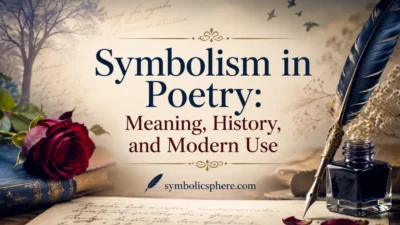
Poetry often communicates more than its words say directly. A bird can suggest freedom, a road can represent a life-changing decision, and a fading flower can evoke the passage of time. These examples of symbolism in poetry show how poets use familiar objects, natural images, and everyday experiences to express ideas that are difficult to explain literally. The Poetry Foundation’s glossary of poetic terms explains how symbols allow poets to suggest deeper meanings through familiar images.
Symbolism gives poems additional layers of meaning without requiring the poet to spell out every emotion or message. Instead of simply telling readers that a speaker feels lonely, a poet might describe an empty house, a silent street, or a single light burning in the distance. The image allows readers to experience the feeling and consider its significance for themselves.
Quick Answer
Examples of symbolism in poetry commonly represent abstract ideas and emotions through concrete images, such as a rose for love, a road for life’s choices, or a bird for freedom. Historically, poets have drawn on religious traditions, mythology, folklore, and familiar aspects of nature to develop symbolic meanings, while modern poets often create new meanings through context and repeated imagery.
TL;DR
- Core meaning: Symbols connect physical images with abstract ideas and emotions.
- Historical roots: Poets have adapted symbols from religion, mythology, folklore, and nature.
- Classic examples: Roads, birds, flowers, seasons, and light frequently carry symbolic associations.
- American literature: Symbols help poets explore freedom, identity, grief, and social change.
- Interpretation: Context, repetition, tone, and imagery reveal a symbol’s possible meaning.
- Modern poetry: Contemporary writers use personal objects and everyday settings as symbols.
What Is Symbolism in Poetry?
Symbolism is a literary technique in which a poet uses an object, person, place, action, or natural event to suggest an idea beyond its literal meaning. A symbol has a physical presence in the poem, but its significance may extend to emotions, beliefs, memories, or social concerns.
For example, a candle can represent hope because its small flame provides light in darkness. A locked door might suggest exclusion, secrecy, or an opportunity that remains out of reach. The meaning depends on how the poet presents the image and how it relates to the rest of the poem.
Symbolism differs from a straightforward comparison. A metaphor directly describes one thing in terms of another, while a symbol can develop significance across several lines, stanzas, or an entire poem. Symbols may also carry several meanings simultaneously.
The important distinction is that not every descriptive detail is a symbol. A storm might simply establish the weather. If the storm repeatedly appears during moments of conflict, however, it may also suggest emotional turmoil or instability.
9 Famous Examples of Symbolism in Poetry
The following examples demonstrate how recognizable images can communicate complex ideas. Each poem uses symbolism differently, showing why context matters when interpreting literary meaning.
1. The Road as a Symbol of Life’s Choices
Poem: The Road Not Taken by Robert Frost (1915)
Robert Frost’s The Road Not Taken is one of the most frequently discussed examples of symbolism in American poetry. Its central image is a traveler standing before two roads in a wooded area, uncertain which direction to follow.
The roads symbolize choices and the uncertainty that accompanies decisions. Once the speaker chooses one route, the alternative becomes a possibility he cannot experience in the same way.
The poem is often presented as a celebration of independence and choosing an unconventional path. However, Frost complicates that interpretation: the speaker initially describes the roads as remarkably similar and later imagines how he will tell the story of his decision.
This distinction matters. The poem explores not only choice but also how people reinterpret their past decisions to give their lives a coherent story.
Why it works: A familiar fork in the road becomes a way to examine regret, memory, uncertainty, and personal identity. The image remains understandable even when readers disagree about the speaker’s feelings. Robert Frost created a symbol that invites interpretation rather than offering a simple lesson.
2. The Bird as a Symbol of Hope
Poem: “Hope” is the Thing with Feathers by Emily Dickinson
In this poem, Emily Dickinson compares hope to a bird that continues singing despite difficult conditions. The bird represents an inner source of encouragement that persists through hardship.
The image works because birdsong can be heard even when the weather is unpleasant. Dickinson uses that familiar experience to suggest that hope does not necessarily depend on comfort, certainty, or favorable circumstances.
The bird is also small and seemingly vulnerable. Yet its persistence gives it a kind of strength that does not rely on physical power.
This makes the poem’s symbolism particularly effective. Hope is not portrayed as a guarantee that problems will disappear. Instead, it is the capacity to continue believing in the possibility of endurance when circumstances are uncertain.
Why it works: The bird turns an abstract emotion into something readers can imagine hearing and experiencing. Its continued song makes hope feel active rather than merely optimistic.
3. The Staircase as a Symbol of Perseverance
Poem: Mother to Son by Langston Hughes (1922)
In Mother to Son, Langston Hughes uses a staircase to represent the difficulties and progress of a human life. The speaker, a mother addressing her son, explains that her life has not been a smooth or comfortable journey.
The staircase contains hazards, damaged boards, and dark stretches. These details represent obstacles that make advancement difficult. Climbing becomes a symbol of perseverance, while reaching landings and turning corners suggests gradual progress through changing circumstances.
The poem’s historical and cultural context also matters. Published during the Harlem Renaissance, it gives voice to a Black mother whose experience reflects hardship, determination, and the importance of passing hard-earned wisdom to the next generation.
The staircase is not simply a general symbol of success. Its damaged condition emphasizes that progress can require persistence in the face of unfair conditions and limited opportunities.
Why it works: Hughes connects a familiar household structure with lived experience, using the mother’s voice to make perseverance personal and socially meaningful.
4. The Rose as a Symbol of Love and Vulnerability
Poem: The Sick Rose by William Blake (1794)
Roses have long been associated with affection, beauty, courtship, and romantic love. Their appearance in poetry often draws on their delicate petals, fragrance, and association with gifts and gardens.
William Blake complicates this familiar image in The Sick Rose. The rose is presented as vulnerable to an invisible worm that secretly destroys it. The flower can be interpreted as representing love or beauty damaged by corruption, secrecy, or destructive desire.
The contrast between the rose’s attractiveness and its hidden injury creates the poem’s tension. Something that appears beautiful on the surface may contain a threat that is difficult to see.
Blake does not provide a single, definitive explanation for every image. Readers may interpret the poem in relation to sexuality, innocence, secrecy, or the destructive effects of concealed behavior.
Why it works: Blake takes an established cultural symbol and makes it unsettling. The rose demonstrates that symbolism can challenge familiar associations rather than simply repeat them.
5. The Raven as a Symbol of Grief and Fixation
Poem: The Raven by Edgar Allan Poe (1845)
Edgar Allan Poe’s The Raven features a mysterious bird that visits a grieving speaker in the middle of the night. The speaker is mourning a lost beloved and becomes increasingly distressed by the bird’s repeated response, “Nevermore.”
The raven’s black plumage, nocturnal arrival, and repetitive speech contribute to its association with death, sorrow, and the permanence of loss. As the poem progresses, the bird becomes connected to the speaker’s inability to escape his grief.
The raven does not need to possess supernatural powers for its symbolic role to be effective. Its presence becomes increasingly disturbing because the speaker repeatedly interprets its words through his own fears and emotional state.
The poem therefore illustrates how a symbol can acquire meaning through a character’s psychological response. The bird’s significance grows as the speaker’s thoughts become more desperate.
Why it works: Poe combines an ominous animal, a grieving narrator, and repetition to make grief feel persistent and difficult to overcome.
6. Light as a Symbol of Hope and Understanding
Light appears frequently in poetry as a symbol of knowledge, hope, clarity, or spiritual insight. Darkness, by contrast, may suggest uncertainty, ignorance, fear, or isolation.
Consider a poem in which a speaker wanders through a dark landscape before noticing a light in a distant window. The light might represent safety, human connection, or the possibility of finding a way forward.
Yet light does not always represent something positive. Harsh light can expose painful truths, reveal wrongdoing, or make a person feel vulnerable. A sudden flash may also suggest danger rather than comfort.
Poets create meaning by choosing the circumstances in which light appears. A candle held by a grieving person communicates something different from a blinding light that exposes a hidden secret.
Why it works: Light and darkness are familiar sensory experiences, making them flexible images for describing changes in knowledge, emotion, and perspective.
7. Water as a Symbol of Change and Renewal
Water is another common image in poetry. Rivers move, rain falls, oceans rise and recede, and streams continue flowing around obstacles. These physical qualities make water useful for representing change, emotional movement, cleansing, renewal, or the passage of time.
A river might represent the movement of life because it continues forward while its surroundings change. Rain could suggest sadness, relief, or the beginning of new growth after a dry period.
Water also carries associations with danger and loss of control. A flood may represent overwhelming circumstances, while a turbulent sea can suggest uncertainty or emotional conflict.
Religious and cultural traditions further shape its meaning. Water is used in cleansing and initiation rituals in several religions, although the significance differs between traditions.
Why it works: Water’s changing physical forms allow poets to express both continuity and transformation. Its meaning depends on whether the image is calm, destructive, cleansing, or unpredictable.
8. Autumn Leaves as a Symbol of Aging and Impermanence
Autumn leaves often represent aging, transition, fading beauty, or the awareness that a period of life is ending. Their changing colors and eventual fall provide a visible reminder that living things pass through different stages.
In a poem about a parent growing older, falling leaves might suggest the approach of life’s final stage. In a poem about leaving home, they might represent the end of childhood and the beginning of adulthood.
Autumn does not always carry a negative meaning. The season can also suggest harvest, maturity, preparation, and the satisfaction of completing a long period of work.
Robert Frost uses autumnal imagery in The Road Not Taken to establish the setting and contribute to the poem’s sense of change and transience. The seasonal details help frame a decision that cannot be revisited in exactly the same circumstances.
Why it works: Seasonal change provides a concrete way to explore time, aging, endings, and the possibility of renewal.
9. Chains as a Symbol of Oppression and Restriction
Chains often symbolize captivity, coercion, social restrictions, or circumstances that prevent people from acting freely. Their literal function of binding objects or people makes them an immediately recognizable image of constraint.
In poetry addressing injustice, chains may represent discriminatory laws, economic exploitation, political oppression, or inherited disadvantages. In a personal poem, they might suggest an unhealthy relationship, addiction, or fear that limits someone’s choices.
Chains can also carry a contrasting meaning when they are broken. The act of breaking them may symbolize liberation, resistance, or the recovery of personal agency.
In American literary and political traditions, images of chains have particular historical weight because of slavery and its enduring consequences. Writers should account for that history when using the image in poems about freedom and inequality.
Why it works: The physical act of restraint makes an abstract social or emotional condition visible. The image becomes especially meaningful when a poem shows who creates the restrictions and whether they can be overcome.
How Symbolism Developed in Poetry
Symbolism did not begin with one literary movement or a single group of writers. It grew from longstanding human practices of using objects, animals, natural events, and images to communicate ideas that extend beyond their literal forms.
Ancient myths and religious traditions connected particular animals, plants, celestial bodies, and natural forces with gods, virtues, dangers, and human experiences. These associations became part of the cultural material that later poets could draw upon.
In European literature, classical mythology and Christian imagery supplied recurring symbols, including the journey, the garden, the serpent, the cross, and the rose. Their meanings developed through stories, ceremonies, visual art, and literary works.
During the Romantic period, poets increasingly used natural landscapes to explore imagination, individual experience, memory, and emotional life. Nature could represent more than scenery; it could become a way of thinking about human relationships and the world.
In the late nineteenth century, the Symbolist movement, particularly influential in France, emphasized suggestion, atmosphere, and associations rather than direct explanation. Its influence helped establish the idea that a poem could create meaning through recurring images, sound, and ambiguity.
Modern poetry has expanded this practice. Writers now draw on city streets, machinery, photographs, household objects, digital devices, and other features of contemporary life. A symbol may inherit a traditional meaning or develop a new one within an individual poem.
What Symbolism Means in American Poetry
American poets use symbolism to explore personal identity, democratic ideals, social inequality, landscapes, and the relationship between individuals and their communities.
The road in Frost’s poetry often invites discussion about individual decisions and the stories people tell about their lives. In Hughes’s work, everyday images can communicate the realities of Black life and the determination to continue despite social obstacles.
American poetry also uses landscapes to examine belonging and displacement. Mountains, rivers, farms, highways, and urban neighborhoods may represent opportunity, isolation, cultural memory, or the consequences of economic and environmental change.
Symbols also appear in poetry about national identity. The eagle, flag, and open frontier have acquired cultural associations with freedom, independence, and the American national story. Poets may embrace these associations, question them, or expose the gap between national ideals and historical realities.
There is no single American interpretation of every symbol. Readers’ experiences, religious backgrounds, communities, and historical knowledge influence how they understand a poem. Effective interpretation recognizes these differences rather than assuming that every image means the same thing to everyone.
Common Symbols and Their Meanings in Poetry
The following table summarizes familiar associations while recognizing that poetic context can change them.
| Symbol | Common association | Possible alternative meaning |
|---|---|---|
| Road or path | Choices and life’s direction | Regret or uncertainty |
| Bird | Hope, freedom, or aspiration | Isolation or foreboding |
| Rose | Love and beauty | Vulnerability or corruption |
| Light | Hope, knowledge, or clarity | Exposure or painful truth |
| Water | Renewal and change | Danger or emotional turmoil |
| Autumn leaves | Aging and transition | Harvest and maturity |
These are interpretive starting points, not universal rules. A poet may deliberately reverse a familiar association or establish a meaning that is unique to the poem.
How to Identify Symbolism in a Poem
Identifying symbolism requires more than recognizing an object with a familiar cultural meaning. The strongest interpretations explain how an image functions within the particular poem.
Start with the literal meaning. Identify what the poet actually describes. Is the image a bird, a window, a river, a staircase, or a particular action? Consider what it does in the scene before assigning it an abstract meaning.
Look for repetition. If an object or image appears several times, ask whether its meaning changes. A window might first suggest curiosity, then separation, and finally the possibility of escape.
Examine the emotional context. Notice the speaker’s feelings, the poem’s tone, and the events surrounding the image. A flower described during a celebration may carry a different implication from one appearing beside a grave.
Consider the title and ending. Titles often introduce an important image, while the ending may change how readers understand something described earlier. Frost’s The Road Not Taken demonstrates how a title and final stanza can complicate an apparently straightforward interpretation.
Test your interpretation against the whole poem. Ask whether the proposed meaning explains several details rather than just one line. If an interpretation contradicts the poem’s language without a convincing reason, reconsider it.
A strong analysis connects the literal image to the larger idea and explains the evidence supporting that connection.
Symbolism vs. Metaphor, Simile, and Allegory
Symbolism is related to several other literary devices, but the terms describe different ways of creating meaning.
| Literary device | How it works | Simple example |
|---|---|---|
| Symbolism | An image suggests an idea beyond itself | A bird represents hope |
| Metaphor | One thing is described as another | “Hope is a bird” |
| Simile | Two things are compared using “like” or “as” | Hope is like a bird |
| Allegory | A sustained narrative communicates a broader meaning | A journey represents a moral or spiritual struggle |
| Imagery | Sensory language creates a mental impression | Rain tapping against a window |
A single line can use more than one device. When a poet describes hope as a bird that continues singing during a storm, the comparison functions as a metaphor, while the bird’s persistence develops symbolic meaning.
Imagery is broader than symbolism because a sensory description does not automatically represent an abstract idea. Allegory differs because its larger meaning generally operates across a more sustained narrative or organized set of correspondences.
Emotional and Psychological Effects of Poetic Symbols
Symbols help poets express emotions that may be difficult to describe directly. Grief, for example, can feel abstract and overwhelming. An image of an empty chair at a family table makes the absence concrete without requiring an extended explanation.
Symbols also allow readers to connect a poem with their own experiences. Someone who has moved to a new city may interpret a road as a symbol of opportunity, while someone facing a difficult decision may see the same image as a reminder of uncertainty.
This personal response does not mean that every interpretation is equally supported. A reader’s feelings are part of the experience, but the poem’s language, structure, and context provide evidence for literary analysis.
Repetition can intensify a symbol’s emotional effect. An image that appears first as a minor detail may become increasingly important as the poem develops. Changes in its surroundings can also alter its meaning, reflecting the speaker’s changing understanding.
The result is a form of communication that combines the poet’s choices with the reader’s interpretation. Symbols create space for reflection without requiring the poem to state every conclusion explicitly.
How Modern Poets Use Symbolism
Contemporary poetry continues to use familiar symbols while drawing on objects and experiences associated with modern life.
A smartphone might represent connection, distraction, surveillance, or isolation. A photograph could symbolize memory, family history, or the difficulty of preserving a moment that has already passed. A freeway may suggest freedom and mobility in one poem but exhaustion, displacement, or environmental damage in another.
Writers also use domestic objects to explore identity and relationships. A packed suitcase can indicate departure, independence, or the pressure to leave. An inherited watch might connect a speaker with family history, mortality, or a relative’s expectations.
These examples illustrate why symbolism remains useful in contemporary literature. Writers do not need to rely exclusively on established cultural symbols. They can develop meaning from ordinary objects by placing them in significant situations, repeating them, or changing how a speaker responds to them.
In digital culture, short poetic excerpts often circulate separately from their original works. Readers may encounter a symbolic image on a social media post without seeing the surrounding lines. The image can still be meaningful, but the original poem may offer a more complicated interpretation.
Common Misunderstandings About Symbolism in Poetry
One common mistake is assuming that every object must represent something else. A tree may simply be a tree, and rain may serve only to establish the setting. Symbolism becomes more convincing when the text provides evidence that an image carries additional significance.
Another mistake is treating symbols as universal codes. A bird may represent freedom in one poem and death or confinement in another. Cultural traditions can provide useful context, but they do not determine the meaning of every literary image.
Readers also sometimes reduce complicated poems to a single moral. The Road Not Taken, for instance, is often treated as a straightforward endorsement of unconventional choices. Its description of the roads and its uncertain ending support a more complicated reading involving memory, interpretation, and the stories people tell about their decisions.
Finally, symbolic interpretation should not replace attention to the poem’s historical context. Hughes’s staircase in Mother to Son gains meaning from the speaker’s voice and the social conditions that shaped the poem’s reception. Ignoring those circumstances can turn a specific literary work into a generic message about perseverance.
The best approach is to remain open to several interpretations while asking which ones the text most strongly supports.
FAQs
What is the easiest example of symbolism in poetry?
A bird representing freedom or hope is an accessible example because readers can connect the image with flight and persistence. Its precise meaning still depends on the poem’s setting, tone, and surrounding language.
What does a rose symbolize in a poem?
A rose commonly suggests romantic love, beauty, affection, or desire. Poets can also use it to represent vulnerability, secrecy, fading beauty, or love damaged by destructive behavior.
What is the difference between symbolism and imagery in poetry?
Imagery uses descriptive language to evoke sensory experiences, such as the sight of falling leaves or the sound of rain. Symbolism occurs when an image also suggests a broader idea, such as aging, grief, or renewal.
Can one symbol have more than one meaning?
Yes. A road can represent independence, uncertainty, regret, or the consequences of making a decision. A poet may deliberately preserve these competing meanings to reflect the complexity of human experience.
Why do poets use symbolism instead of stating their meaning directly?
Symbols let poets communicate emotions and ideas indirectly, giving readers room to make connections. They can also bring several associations into a single image, allowing a short poem to express more than a literal explanation might convey.
How do I explain symbolism in a school essay?
Identify the symbol, describe its literal role in the poem, and explain the larger idea it suggests. Support your interpretation with relevant details and show how the image contributes to the poem’s overall meaning.
Are symbolic meanings the same across cultures?
No. Some associations are widely recognized, but symbols can carry different meanings across cultures, religions, historical periods, and individual works. Readers should consider the context rather than assuming that a symbol has one universal interpretation.
Conclusion
Examples of symbolism in poetry show how ordinary images can communicate ideas about love, freedom, grief, perseverance, identity, and change. From Dickinson’s bird of hope to Hughes’s difficult staircase and Frost’s uncertain roads, poets transform familiar experiences into ways of exploring complicated human questions.
Understanding a symbol requires attention to more than its conventional meaning. The poet’s language, the image’s place in the work, the historical context, and the reader’s response all help shape its significance. The Poetry Foundation’s guide to symbols in poetry offers further insight into how concrete images can communicate abstract ideas.
When reading a poem, begin with what the image literally represents, then consider what it suggests and how the rest of the poem supports that interpretation. The most convincing reading is not necessarily the most elaborate one, but the one that best explains why the poet chose that particular image.